Xeriscaping vs. Artificial Turf: Which Saves More Water in Arizona?
Xeriscaping vs. Artificial Turf: Which Saves More Water in Arizona?
How Much Water Does Each Option Actually Save?
What a traditional Arizona lawn actually costs you in water
Xeriscaping's water savings, and the drip irrigation nobody mentions
Artificial turf's water savings, zero ongoing irrigation
Side-by-side verdict, which one wins on paper
The Catch Most Comparison Articles Skip: Rebates
Which Valley cities pay you to xeriscape
Where artificial turf gets excluded, or capped
How the net cost math actually shifts once rebates are in the picture
The Heat Tradeoff Nobody Wants to Talk About
How hot artificial turf actually gets in an Arizona summer
Xeriscape rock and gravel get hot too, here's the research
Why summer heat quietly eats into turf's water savings
Cost and Maintenance Over the Long Haul
Upfront installation cost, side by side
So Which One Actually Saves You More Water in Arizona?
When xeriscaping is the better call
When artificial turf is the better call
If you've lived in the Valley through even one August water bill, you've probably asked yourself this question standing in your dead front lawn. Xeriscaping and artificial turf both get pitched as "the answer" to Arizona's water problem, and honestly, both of them are pretty good answers. But they're not the same answer, and the folks selling you one option usually aren't in a hurry to point out where the other one wins.
So let's actually run the numbers. No spin, just what the water bill, the rebate paperwork, and the thermometer have to say.
How Much Water Does Each Option Actually Save?
What a traditional Arizona lawn actually costs you in water
Start with the baseline you're trying to beat. A standard Bermuda or fescue lawn in the Valley needs about an inch to an inch and a half of water a week during the hot months, which works out to roughly 55 gallons per square foot per year, based on irrigation research from the Southern Nevada Water Authority (a group that's been studying Southwest lawn watering for decades). Stretch that across a modest 2,000 square foot yard and you're pouring over 100,000 gallons a year onto grass. That's the number both xeriscaping and artificial turf are competing to beat.
Xeriscaping's water savings, and the drip irrigation nobody mentions
Swap that lawn for native and drought-tolerant plants, gravel, and decorative rock, and most homeowners see outdoor water use drop by 50 to 75 percent. Here's the part a lot of xeriscaping pitches leave out though: xeriscaping isn't a zero-water landscape. Those agave, yucca, and palo verde trees still need water, especially while they're establishing, and most installers recommend a drip irrigation system to keep everything alive through July and August. So xeriscaping saves a lot of water. It doesn't eliminate the water bill line item entirely.
Artificial turf's water savings, zero ongoing irrigation
Artificial turf skips that step altogether. Once it's installed, there's no root system to water, no drip line running, nothing to keep alive. The only water turf uses going forward is whatever you spray down for cleaning or cooling (more on that below). On pure irrigation elimination, turf gets you closer to zero than xeriscaping does.
Side-by-side verdict, which one wins on paper
If the only question is "which yard uses the least water going forward," artificial turf edges out xeriscaping, since xeriscaping still carries some ongoing irrigation and turf carries none. But "which saves more water" and "which is the better financial decision" turn out to be two different questions in Arizona, and that's where things get interesting.
The Catch Most Comparison Articles Skip: Rebates
Which Valley cities pay you to xeriscape
Here's the part almost nobody puts next to the water numbers. A bunch of Arizona cities will straight up pay you to remove grass and replace it with xeriscaping. Phoenix offers up to $3,000 for a qualifying xeriscape conversion. Scottsdale pays based on square footage removed. Mesa and Chandler run their own tiered rebate programs too, with Chandler capping residential rebates at $2,000 per property.
Where artificial turf gets excluded, or capped
Now here's the catch: several of those same programs specifically exclude artificial turf. Chandler's residential rebate policy states plainly that any area converted to artificial turf does not qualify, full stop. Glendale allows turf on new-home conversions but caps it at a much smaller amount than its xeriscape rebate. It's not universal though. Queen Creek's residential turf conversion program actually allows up to 1,000 square feet of artificial turf as part of a qualifying project, paying $2 per square foot (up to $5,000 total), as long as the rest of the yard hits a 30 percent live plant canopy requirement. We broke down the full Queen Creek program if you're in that area. Some West Valley and Maricopa County programs allow turf too. But if you're a residential homeowner in one of the bigger Valley cities, there's a real chance your city will hand you a check for xeriscaping and hand you nothing for turf.
How the net cost math actually shifts once rebates are in the picture
This is the number that changes the whole conversation. Run a 1,000 square foot yard through both scenarios: xeriscaping might land you $2,000 to $7,000 back depending on your city, while the identical square footage in artificial turf, in a city that excludes it, gets you zero. Same water savings story on paper, very different number on the invoice. Before you decide which option "wins," it's worth a five-minute call to your water provider to check what your specific city currently offers, since these programs change year to year.
The Heat Tradeoff Nobody Wants to Talk About
How hot artificial turf actually gets in an Arizona summer
Nobody selling turf loves talking about this one, but it matters. On a hot July afternoon, artificial turf surfaces have been measured at university test sites reaching close to 200°F, with research out of BYU and Penn State both landing in that range. That's not exaggeration, that's a thermometer on the ground. Natural grass on the same day usually stays somewhere between 75°F and 102°F, since it cools itself through evapotranspiration. Cooling infill can knock 30 to 50 degrees off turf's surface temperature, and it's worth asking about if bare feet, pets, or kids are part of your backyard plans.
Xeriscape rock and gravel get hot too, here's the research
Before you swing all the way to xeriscaping to dodge the heat problem, know that rock and gravel aren't cool customers either. University of Florida research found that xeriscape yards can run up to 54°F hotter than yards with living grass. Neither desert-friendly option keeps things cool the way grass does. Both trade cooling for water savings, just in different ways.
Why summer heat quietly eats into turf's water savings
Here's the twist that connects heat back to the water question. A lot of turf owners end up hosing their yard down on the hottest days just to make it usable, since a quick soak can drop the surface temperature 30 to 50 degrees. That's not a huge amount of water compared to what a lawn would need, but it does mean turf's "zero water" pitch comes with a small asterisk in peak summer if you actually want to use the space.
Cost and Maintenance Over the Long Haul
Upfront installation cost, side by side
Both options land in a similar ballpark going in. Artificial turf in the Phoenix metro typically runs $8 to $18 per square foot installed, depending on turf quality, base prep, and any pet or cooling upgrades. Xeriscaping installation costs vary more based on plant selection and hardscaping, but often comes in at the lower end of a similar range for a basic rock-and-plant design. Neither one is the "cheap" option compared to just doing nothing, but both beat a natural lawn once you factor in what grass costs every single year.
What happens at year 15 to 20
This is where the long game matters. Artificial turf has a lifespan of roughly 15 to 20 years, after which the fibers wear down and it needs a full replacement, meaning you're looking at another $5,000 to $20,000 bill down the road for a typical yard. Xeriscaping doesn't have that same expiration date. Established native plants keep growing, and your ongoing cost is more along the lines of $200 to $500 a year for mulch refreshes and occasional pruning, not a full teardown and rebuild.
So Which One Actually Saves You More Water in Arizona?
The honest answer
Artificial turf saves slightly more water than xeriscaping, since it eliminates irrigation entirely while xeriscaping still needs some. But xeriscaping usually saves you more money overall once rebates enter the picture, and it stays cooler underfoot too. Anyone telling you one option is simply "better" across the board is skipping half the story.
When xeriscaping is the better call
If your city offers a solid rebate, if keeping surface temperatures down matters to you, or if you want a yard that never needs replacing, xeriscaping is the stronger fit.
When artificial turf is the better call
If you want a usable green space for kids or pets, if your yard sees heavy foot traffic, or if you want the closest thing to zero ongoing water use with the least maintenance, artificial turf is the stronger fit.
Why a lot of Valley homeowners end up doing both
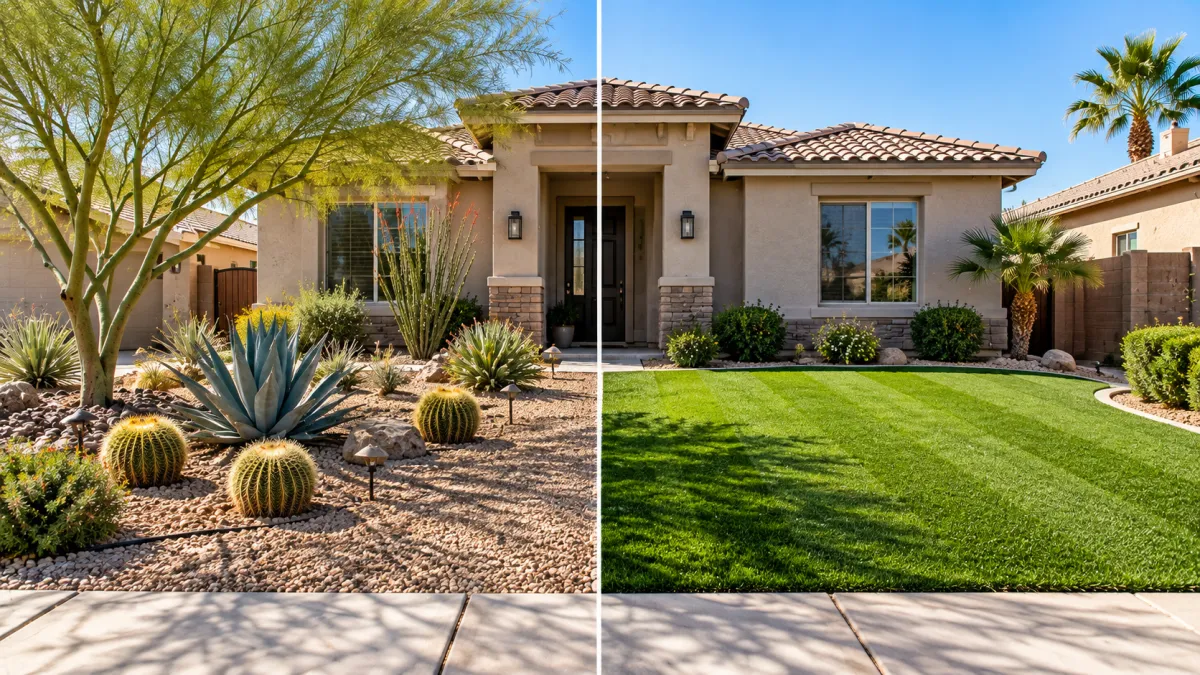
This is honestly where most smart Arizona yards land. A turf area for the kids or the dog, bordered by xeriscaped beds with native plants, gets you the usability of turf, the rebate-eligible water savings of xeriscaping on part of the property, and a cooler, more natural look breaking up all that green. It's not an either-or decision as often as the marketing makes it sound. Browse our portfolio to see how Valley homeowners have combined the two.
If you're ready to compare options for your own yard, get in touch with our team for real numbers based on your square footage and your city's current rebate status.
Xeriscaping vs Articial Turf FAQs
Does xeriscaping or artificial turf save more water in Arizona?
Artificial turf saves slightly more, since it needs zero ongoing irrigation while xeriscaping still typically uses some drip irrigation to keep plants alive. Both cut water use dramatically compared to a traditional lawn.
Can I get a rebate for installing artificial turf in Arizona?
It depends on your city. Some Valley cities exclude turf from their rebate programs entirely (Chandler is one example), while others, like Queen Creek, allow a limited amount of turf as part of a qualifying project. Check with your local water provider before you budget around a rebate.
How hot does artificial turf actually get in an Arizona summer?
University testing has recorded surface temperatures approaching 200°F on hot afternoons. Cooling infill can bring that down by 30 to 50 degrees, which is worth asking about if you have kids or pets using the space.
Is xeriscaping cheaper than artificial turf long term?
Often, yes. Installation costs are similar upfront, but xeriscaping frequently qualifies for city rebates that turf doesn't, and it doesn't carry turf's 15 to 20 year replacement cost.
Can I combine xeriscaping and artificial turf in the same yard?
Yes, and a lot of Arizona homeowners do exactly that: turf for the usable, high-traffic areas, xeriscaping for the borders and low-traffic beds.
Sources: Southern Nevada Water Authority irrigation research; Scottsdale Water conservation program data via 12News/KPNX; Chandler residential water conservation rebate policy; City of Phoenix xeriscape conversion rebate program; Town of Queen Creek Residential Turf Conversion Incentive Program; BYU and Penn State artificial turf surface temperature testing; University of Florida turfgrass research.